

When people think about a solar power plant, the first image that usually comes to mind is a field of photovoltaic modules.
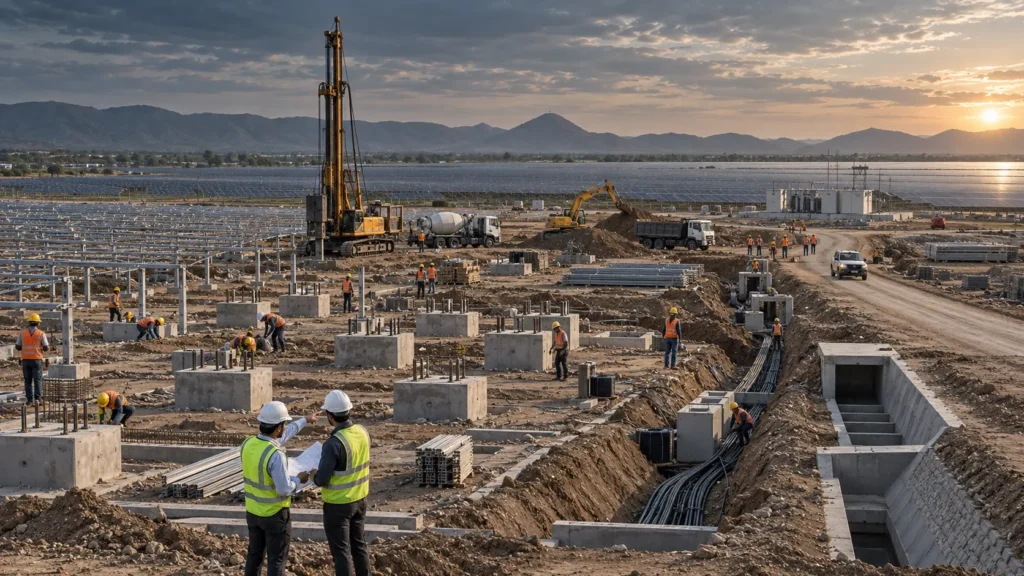
But before those modules can generate electricity, a considerable amount of civil infrastructure has to be created underneath and around them.
For large-scale solar projects, civil works are not simply supporting activities. They form the physical foundation of the project.
Starting With the Site
Every solar project begins with the land.
Site preparation can include earthwork, excavation, grading and development of areas required for project construction. These activities help create workable conditions for subsequent infrastructure.
The site itself can introduce different challenges depending on terrain, soil conditions, drainage requirements and access.
That is why execution needs to be based on the realities of the project site.
Piling and Foundations
Ground-mounted solar structures depend on properly executed foundations.
Piling creates the structural support needed for mounting systems, while foundation and RCC works help establish stable infrastructure for associated project components.
For large-scale projects, consistency becomes particularly important. Repeated foundation works have to maintain the required quality and alignment across the project area.
BKD ARCON’s documented project experience includes tracker pile foundation works and multiple foundation-related infrastructure activities.
Roads Are Part of the Infrastructure
Internal roads may not be the most visible part of a solar plant, but they are essential to project movement.
Construction teams, maintenance personnel, vehicles and equipment need practical access across the site.
Well-planned internal roads can support construction logistics as well as later operational requirements.
Road construction is therefore closely connected to the overall usability of the project site.
Cable Trenches and Electrical Infrastructure
A solar plant also needs pathways for its electrical systems.
Cable trenching and LT/HT cable laying form part of the infrastructure required to connect different areas of the plant.
These works need coordination with civil construction so that electrical infrastructure can be installed without disrupting other project activities.
Drainage Cannot Be an Afterthought
Water management is another important part of site development.
Storm-water drainage helps manage water movement across a large project area and can be particularly important in locations where rainfall events create concentrated runoff.
Drainage infrastructure must work together with the site’s grading, roads and surrounding construction.
The company’s documented capabilities include storm-water drains and water infrastructure, as well as multiple drainage projects within its project portfolio.
Boundary Infrastructure and Site Protection
Large solar projects also require controlled boundaries.
Boundary fencing, access points and associated infrastructure help define the operational area of the plant and support site management.
These elements connect naturally with industrial security requirements, especially where valuable equipment, cables and modules are present.
Civil Works as a Connected System
One of the most important things to understand about solar civil infrastructure is that individual activities do not exist in isolation.
Site preparation influences piling.
Piling influences structural installation.
Roads influence logistics.
Drainage influences site usability.
Cable trenches connect civil and electrical work.
Fencing connects physical infrastructure with security.
The better these elements are coordinated, the more efficiently the project can progress.
Why Execution Matters
The technical design of a solar project is important, but execution determines how that design is translated into a working physical asset.
Strong project execution requires planning, quality checks, site coordination and attention to actual ground conditions.
BKD ARCON’s documented approach includes QA/QC processes, material inspection, site inspection, work documentation and project coordination.
Conclusion
A utility-scale solar plant is not built only from solar modules.
It is built from land preparation, foundations, roads, drainage, cable infrastructure, structures, electrical systems and countless coordinated site activities.
That is why civil infrastructure deserves to be considered one of the foundations of successful solar project execution.