

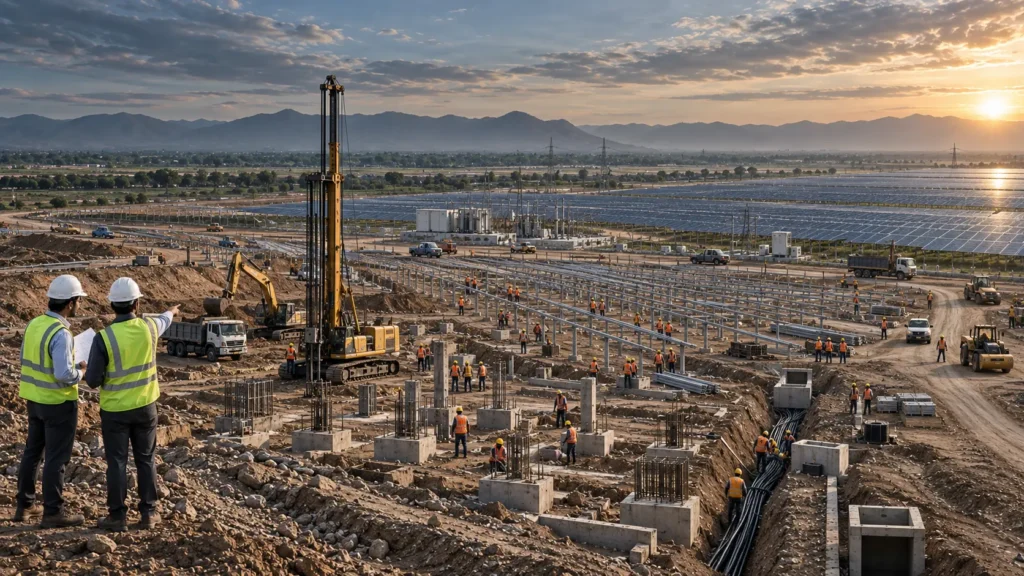
Large solar projects are built through a sequence of connected activities.
The finished plant that appears simple from a distance is the result of weeks, months or longer of planning, site work, construction, installation, testing and commissioning.
Understanding this sequence helps explain what goes into reliable project execution.
Stage 1: Understanding the Project
Execution begins with understanding the scope.
Project requirements, site conditions, infrastructure needs, execution priorities and available resources all need to be considered before work begins.
A project plan is useful only when it can be translated into practical site activities.
Stage 2: Preparing the Site
The land has to be prepared for construction.
This may include earthwork, excavation, grading and development of access areas.
Site preparation establishes the working environment for the next phases of the project.
Stage 3: Piling and Foundations
With the site ready, structural support can be developed.
Piling and foundations provide the basis for solar mounting structures and associated infrastructure.
Quality at this stage matters because later construction depends on the consistency and stability of the underlying work.
Stage 4: Building Supporting Infrastructure
A solar project needs much more than mounting structures.
Internal roads help move people and equipment across the site.
Drainage infrastructure manages water movement.
Cable trenches create pathways for electrical systems.
Boundary fencing helps define the project area.
Inverter stations and control rooms support the plant’s electrical infrastructure.
These supporting systems are what turn a collection of panels into a functional project environment.
Stage 5: Installation
The project then moves into installation activities.
Solar modules, mounting systems and electrical infrastructure are installed according to project requirements.
Different teams may be working simultaneously, making coordination increasingly important.
Stage 6: Testing and Commissioning
Installation is followed by testing and commissioning.
This stage helps verify that project systems are ready to move from construction toward operation.
The broader Solar EPC process documented for BKD ARCON includes engineering, design, procurement, construction, installation, testing, commissioning and handover.
Stage 7: Handover
Once commissioning activities are completed, the project moves toward handover.
Documentation, coordination and completion of required project activities become important during this transition.
A structured handover helps create a clear bridge between project construction and ongoing operations.
Stage 8: Operations and Maintenance
A solar plant is built to operate for the long term.
That makes post-construction support important.
Operations and maintenance activities can help monitor the plant, address operational requirements and support the continued functioning of project infrastructure.
BKD ARCON’s documented solar services include O&M as part of the overall solar project lifecycle.
Where Quality and Safety Fit In
Quality and safety are not separate steps at the end of a project.
They should be present throughout execution.
Site inspections, material checks, work documentation, PPE, toolbox talks, risk assessment and safe work practices all contribute to responsible execution.
Why Project Coordination Matters
The stages of a solar project are connected.
A delay in site preparation can affect foundations.
Foundation delays can affect structure installation.
Infrastructure delays can affect electrical works.
Installation delays can affect testing and commissioning.
That is why project execution benefits from a structured approach in which activities are planned as part of one connected workflow.
Conclusion
From the outside, a solar plant may look like a field of panels.
From the project side, it is a carefully coordinated sequence of engineering, civil works, infrastructure development, installation, testing and commissioning.
The quality of the finished project depends on how effectively each stage connects to the next.